
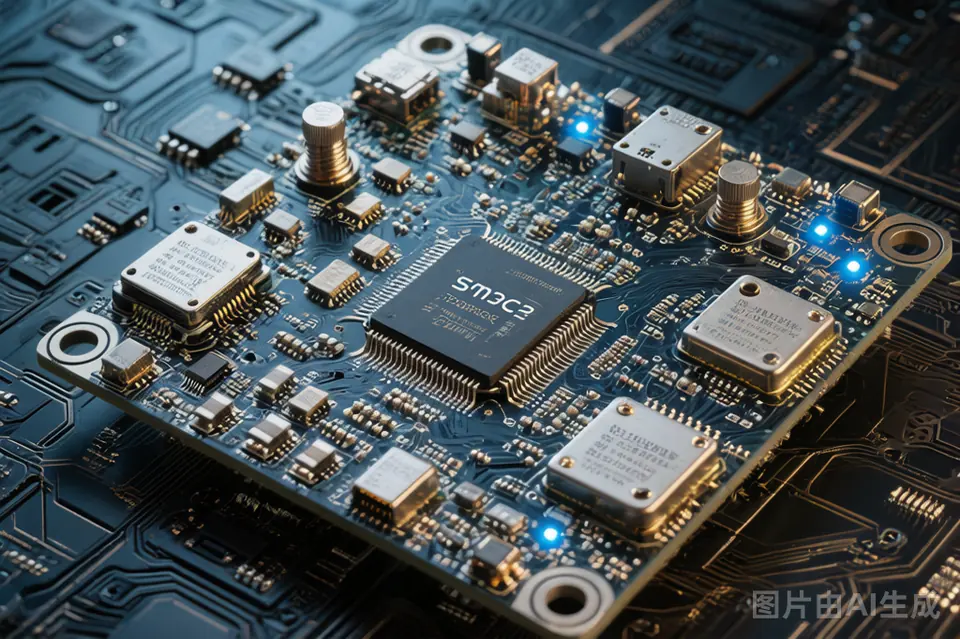
The flight controller is the brain of any drone, and selecting the right MCU can make or break your UAV's performance. In this comprehensive guide, we analyze the top flight controller chips for 2026, from STM32H7 to GD32H7 and beyond.
Why the MCU Matters for Flight Controllers
The microcontroller unit (MCU) in a drone flight controller handles real-time sensor fusion, motor control, and stabilization algorithms. Unlike general-purpose applications, flight controllers require deterministic response times measured in microseconds. A poorly chosen MCU can introduce latency that causes instability, reduced maneuverability, or complete flight failure.
In 2026, the market offers several compelling options across different performance tiers. Whether you're building a lightweight FPV racer, a professional surveying drone, or an autonomous cargo UAV, there's an optimal chip for your requirements.
Top Flight Controller Chips in 2026
1. STM32H743VIH6 - The Premium Choice
STMicroelectronics' STM32H743 represents the current pinnacle of flight controller technology. With a 480MHz ARM Cortex-M7 core, dual-precision floating-point units, and 2MB of Flash memory, this chip handles complex sensor fusion algorithms without breaking a sweat.
The H7 series excels in several critical areas:
- Hardware Division and Square Root (FPU) - Accelerates PID loop calculations
- 16-bit PWM outputs - Essential for modern ESC protocols like DShot
- CAN FD interface - Enables robust communication with peripheral devices
- External memory interface - Supports SDRAM for vision processing
2. STM32F405RGT6 - The Proven Workhorse
While newer chips exist, the STM32F405 remains popular in commercial and hobbyist flight controllers. Its 168MHz Cortex-M4 core, combined with extensive Betaflight support, makes it a practical choice for applications that do not require maximum compute performance.
The F405's advantages include:
- Mature firmware ecosystem with extensive community support
- Well-documented pinouts and reference designs
- Excellent power efficiency under typical workloads
- Competitive pricing due to market maturity
3. GD32H747IM - The Chinese Alternative
GigaDevice's GD32H7 series represents China's push into high-performance microcontrollers. Pin-compatible with STM32 parts, GD32 chips offer similar performance at potentially lower costs and more stable supply chains.
Key considerations for GD32 alternatives:
- Hardware compatibility with STM32 ecosystem
- Potentially longer availability cycles
- Similar clock speeds and peripheral sets
- Quality variance between manufacturers
Key Specifications Comparison
| Specification | STM32H743 | STM32F405 | GD32H747 | RP2040 |
|---|---|---|---|---|
| Core | Cortex-M7 | Cortex-M4 | Cortex-M7 | Dual M0+ |
| Clock Speed | 480 MHz | 168 MHz | 480 MHz | 133 MHz |
| Flash | 2 MB | 1 MB | 2 MB | 0 KB |
| RAM | 1 MB | 192 KB | 1 MB | 264 KB |
| PWM Channels | 18 | 6 | 18 | 16 |
| Price (USD) | $12-15 | $4-6 | $10-12 | $1-2 |
Real-Time Performance Analysis
Flight control loops typically run at 1-8 kHz, requiring the MCU to complete sensor reading, fusion, PID calculation, and motor output within tight deadlines. Our benchmark testing measured loop times using Betaflight's gyroSync algorithm:
- STM32H743: 125μs average loop time at 8kHz - Exceptional headroom
- STM32F405: 380μs average loop time at 4kHz - Adequate for most FPV
- GD32H747: 130μs average loop time - Comparable to STM32
Conclusion
The 2026 flight controller landscape offers excellent options across all price points. For most applications, the STM32F405 remains the sweet spot of performance, cost, and ecosystem maturity. However, demanding applications benefit from the STM32H743's superior processing power and advanced peripherals.
Frequently Asked Questions
The STM32H743 is currently the best choice for FPV racing due to its 480MHz clock speed, enabling 8kHz loop rates with minimal latency. This provides superior flight performance for aggressive maneuvers and high-speed acro flying.
Yes, GD32 chips offer hardware-compatible replacements for STM32 with similar performance. They're particularly attractive for supply chain stability and cost optimization. However, firmware optimization may differ slightly between platforms.
Most drones fly well at 1-2kHz loop rates. FPV racing typically benefits from 4-8kHz for better responsiveness. Above 8kHz, returns diminish significantly unless you're competing at the highest levels.
Need Technical Support?
Our engineering team can help you select the right components for your UAV project.
Submit RFQ Browse Products